How My Cambridge Summer Became a Turning Point
Updated: Dec 4, 2025
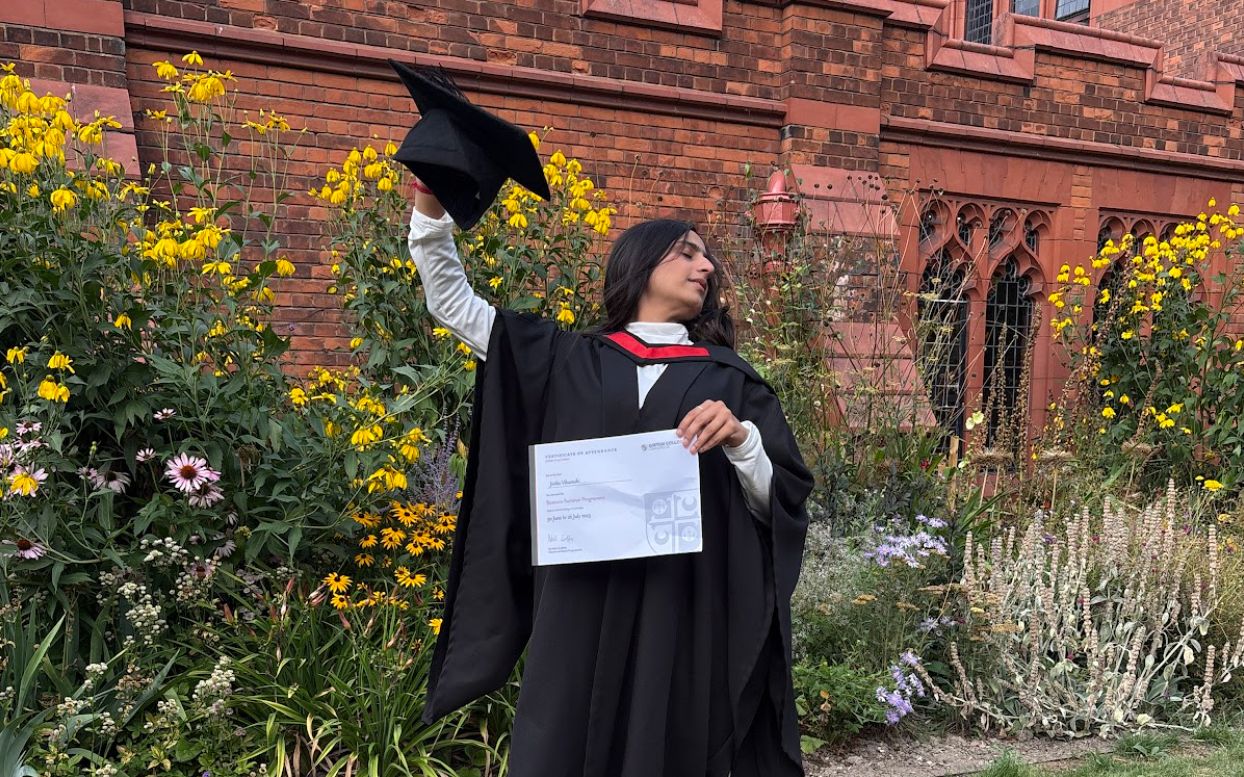
Written by Jivika Vikamshi, participant of the Summer Programme at Girton College, Cambridge
The Warmest Day in Cambridge
Cambridge wasn’t supposed to feel like this.
In my imagination, it was always misty and cold, wrapped in scarves and the smell of rain-soaked stone. But the day I arrived, it was warm -almost too warm. The streets shimmered under the sun as bicycles darted past me, bells chiming sharp little notes into the air. People rushed into meetings, disappeared behind heavy wooden doors, their voices trailing off into courtyards older than memory.
And I stood still, clutching my suitcase, trying to believe that this wasn’t a dream.
I come from Hubballi, a small town in India where the name Cambridge was something you heard with reverence. My dadu said it was like a crown. Teachers pointed to it as a pinnacle. “This person studied at Cambridge,” they’d whisper, as though saying the word too loudly might break its magic. As a child, I used to secretly think, what if one day, that could ever be me?
But even when I whispered it, I didn’t fully believe it. Cambridge was a word for other people, from other places. For the brilliant, the extraordinary. Not for a girl, who fumbled writing a short piece of essay in her 8th grade. And yet, there I was - dragging my tired body across cobblestones that once carried Darwin, Hawking, and thousands of minds I’d only read about. The air was thick with history, but also with disbelief. Every step I took was heavy with the weight of people who had believed in me long before I believed in myself: my parents, who carried my ambitions like their own; my grandfather, who dreamed bigger than his times allowed; my teachers, who stayed late after school so I could ask one more question.
To them, Cambridge was the unreachable star. To me, it was the reminder that maybe stars could be touched. That first day, I cried. Not politely, not a single cinematic tear. I cried through the induction, I cried as I sat in my room, I cried when I caught my reflection in the mirror wearing the lanyard with the crest of the University of Cambridge printed on it. Because it might not be the biggest thing for everyone, but for me - it was the biggest.
And as I stood there, alone in that unseasonably warm Cambridge air, I heard the voice of the city itself.
“You don’t have to prove you belong here,” Cambridge seemed to say. “You already do.”
In that moment, the disbelief melted into something else. Not arrogance, not certainty, but a kind of quiet acceptance. Maybe I wasn’t here to compete. Maybe I was here to learn, to breathe, to discover.
And maybe - just maybe - I was here to tell the girl in Hubballi, the one sitting cross-legged with a book in her lap, whispering Cambridge under her breath like a prayer: You made it. One day, you will stand on these streets. And you’ll know you were enough all along.
Myth vs. Reality
In my head, Cambridge was always going to be brutal. Four weeks of solitude, of staring at notes until the words blurred, of sitting in lecture halls surrounded by people who were all smarter, sharper, faster. I pictured myself shrinking into the background, polite smile plastered on, retreating back to my room after class to journal about how out of place I felt.
That was the myth.
The reality? I didn’t retreat once.
Instead, I woke up wanting to be in the classroom. Even at 8:45 a.m. - the hour no university student on earth voluntarily chooses - I wanted to be there. Because the professors didn’t just deliver lectures. They provoked, they challenged, they played. They looked you in the eye and asked you a question that left you buzzing for hours after class. And you realised quickly: this wasn’t about being the “smartest” in the room. It was about being alive in the room.
And somehow, the girl who thought she’d spend her days in silence found herself laughing across courtyard benches, debating strategy over sandwiches, getting drawn into conversations that carried on long after lectures ended. The kind of conversations that weren’t just about business frameworks but about life, about what it means to lead, about how people in five different continents all carry the same hunger inside them.
I thought I’d come here to prove I could survive Cambridge. Instead, Cambridge showed me
something else: you don’t survive here. You participate. You belong.
Cambridge as a Character
Cambridge doesn’t just exist; it performs. Every morning, it greeted me with bicycle bells and the rhythm of footsteps against cobblestones, like a soundtrack arranged centuries before I arrived. The buildings leaned in close, as if they wanted to whisper secrets - secrets of every mind that had once walked beneath their arches.
Cambridge isn’t intimidating in the way I thought it would be. It isn’t cold or closed-off. It’s curious. It looks at you, tilts its head, and asks: “So, what do you have to bring?”
Some days it felt sharp, bustling, impatient - the air filled with clipped conversations as students rushed to their lectures. Other days, it softened: the slow ripple of the River Cam, the way the light slid across King’s Chapel at sunset, the hush of a library where time itself seemed to pause.
Cambridge taught without speaking. It reminded me that a city can hold contradictions and still make sense: rigorous yet playful, ancient yet alive, global yet deeply intimate. Walking through it, I felt less like a visitor and more like a participant in an unfolding play - one in which the city itself was both stage and actor.
And that’s what Cambridge gives you. Not just a programme. But also Jack’s Gelato - the best in the world. (Trust me, you’ll learn your economics lectures better when you’ve got a scoop of apple elderflower in hand.)
It’s strange, but after a while you stop noticing where the people end and Cambridge begins. The energy of the classrooms, the conversations in the courtyards, the quiet awe of standing in places that carry centuries of thought - they all blur into one presence. One character who insists you step up, not to impress it, but to discover yourself within it.
And maybe that’s what makes Cambridge unforgettable. It doesn’t just give you a programme to complete. It gives you a dialogue - between you and the city, between who you were when you arrived and who you’re daring to become when you leave.
The Rooms That Changed Me
The classrooms at Cambridge weren’t silent spaces of note-taking; they were arenas. Every seminar felt like stepping into a new experiment - professors tossing us questions that didn’t have neat answers, pushing us to stretch our minds and occasionally our patience.
One afternoon, instead of talking about investing with slides and formulas, we played poker. Yes, actual poker. Chips stacked, cards shuffled, strategies whispered. The assignment was simple: survive the round. The lesson, of course, was not. Risk, timing, psychology, probability - it was all there on the table, disguised as a game. And the best part? I actually won. That moment did more for my understanding of investment than any textbook ever could.
But it wasn’t all games. Essays loomed over us like storm clouds. We cried a little while planning, argued a lot while editing, and then celebrated as though we’d conquered mountains when we finally submitted. Presentations were the same - chaotic rehearsals, last-minute slides, hearts thudding as we spoke. Yet each one felt like a performance worth remembering.
And then, when the sun dipped, Cambridge switched costumes. We traded whiteboards for long wooden tables in halls that looked straight out of Hogwarts. Formal dinners were candlelit and majestic - high ceilings, robes swishing, the murmur of Latin grace before the food arrived. As a Harry Potter fan, I kept waiting for Dumbledore to stand up and make an announcement. Instead, we clinked glasses, complimented each other’s outfits, and laughed like old friends in a room that smelled of history and roast chicken.
Even the libraries turned into lessons. Walking past centuries-old manuscripts, I thought of all the students who had stood where I was, wrestling with their own essays and doubts. It felt less like a tour and more like joining a secret society of thinkers across time.
Cambridge learning was rigorous, yes. But it wasn’t the rigor I feared. It was a rigor that invited you to play, to fail, to try again, to cry, to laugh, to taste both exhaustion and exhilaration in equal measure. And that is what made it unforgettable.
Collecting Souls Across the Globe
The magic of Cambridge didn’t arrive with trumpets; it crept in quietly, in the most ordinary moments. A joke exchanged in the courtyard, a compliment whispered before a formal dinner, someone sliding a coffee across the table before a presentation. That’s how strangers became friends, and friends became family.
Our Hogwarts dinners became our ritual. We’d dress up, fuss over each other’s earrings and ties, and walk into halls glowing with candlelight. Somewhere between the Latin grace and the first bite of dessert, we’d be giggling like schoolchildren, secretly waiting for Dumbledore to appear.
Then came the nights - karaoke that started politely and ended with us screaming lyrics into the microphone, games that made us laugh until our cheeks hurt, birthday cakes cut in a rush of music and chaos. There were essays, yes, and sometimes tears - but also people sitting beside you, saying, we’ll figure it out together.
It’s hard to explain how four weeks can hold so much. But it’s in the small things: the way Kaylee’s laughter felt like sunlight, Lily calling me mommy in the middle of class, Gabriela pressing a Van Gogh notebook into my hand as if to say don’t stop writing. It was in the promises made under courtyard skies, in the tears we never expected to cry, in the way goodbye felt like tearing a page you wanted to keep reading.
Cambridge taught me strategy, yes. But more than that, it gave me people I never knew I needed - people scattered across the world, carrying little pieces of me back with them.
Weekends That Became Memories
If there was one rule we lived by, it was: no weekend goes wasted. Four weekends, four adventures. Every Friday felt like the beginning of a new story -bags packed, train tickets clutched, and a pact with my girls that we’d squeeze every ounce of magic out of this programme.
London was a blur of long walks and tired feet, but somehow our energy never ran out. Oxford had us wandering through courtyards that felt stolen out of history, teasing one another about whether Cambridge might still be the prettier sibling. Edinburgh was wild - the wind slapped us across the face at Arthur’s Seat, but we stood there laughing, because some moments deserve the kind of silence only laughter can break.
And then there were the little things: late-night birthday celebrations where the cake always tasted better after midnight, town walks where streetlamps felt like our only witnesses, and dinners that looked suspiciously like Hogwarts feasts - honestly, I kept waiting for a floating candle to drop.
Somewhere between essays and karaoke nights, I also managed to recruit a new Maggi fan. Gabby went back home with seven or eight packets in her bag --proof that my campaigning worked. (Bharat, you’re welcome.)
A Shakespeare Dream Come True
One evening we dressed up for the theatre, not just any play but As You Like It. I remember sitting down and thinking how eighth-grade me would have been in tears if she knew this day was coming. Watching Shakespeare performed live, in England, felt like one of those circle-of-life moments - the kind that makes you want to whisper to your younger self, you’ll get here, just wait.
The Goodbyes
No one warns you that the hardest part of Cambridge isn’t the essays, the presentations, or even the early mornings. It’s the goodbyes. Four weeks slipped through our hands faster than we realised, and suddenly we were staring at our suitcases, trying to fit in not just clothes but entire memories.
I remember walking down the Girton corridors for the last time, and everything looked the same yet felt different. The walls, the dining hall, the gardens — they all seemed to whisper, you were here, you belonged, and now you’re leaving stronger than you came.
The final night was the hardest. We laughed louder than usual, as if trying to capture joy in a bottle. We hugged tighter, holding on just a second longer because we knew distance was about to separate us. And yet, even in the heaviness of leaving, there was a thread of hope - we made pacts, whispered promises that this wouldn’t be the end. See you soon, we said, and this time we meant it.
Because when bonds are built on something as rare as what we had, they don���t break with distance; they stretch across it.
That night I realised something: you don’t truly leave Cambridge. You carry it with you. In the friendships that feel like family, in the courage that now feels permanent, and in the quiet confidence that wherever I go next, I’ve already proven to myself - I can belong anywhere.
Gratitude
If there’s one thing this journey taught me, it’s that opportunities like this don’t just appear - they are created by people who believe in the power of education to change lives. And for that, I owe my deepest gratitude to the Global Education Lab.
They gave me more than a programme; they gave me a space where curiosity could roam free, where friendships could spark across continents, and where risks turned into rewards. Without this platform, I wouldn’t have met the souls who now feel like sisters, or stood in halls that made history feel alive, or tested my own limits in ways that will shape me for years.
And to my parents - the bravest ones of all. As protective as they were, they chose my growth over their fears, and that was a risk even greater than mine. Sending their daughter out into the world wasn’t easy, but their faith in me is the reason I could stand here today. The biggest thank you will always be to them.
To be trusted with this opportunity was an honour, and to live it fully was a privilege. For that, I will always carry a quiet thank-you in my heart - every time I speak of Cambridge, every time I draw strength from the lessons it left behind.
The Risk & The Reward
If there is one truth I want to leave with anyone reading this, it is this: no one is coming to do it for you. No one will knock on your door and hand you the life you’ve dreamed of. No one will take the step you’re too afraid to take. That first move has to come from you. And yes - it will feel terrifying. You will question whether you’re ready, whether you belong, whether you’ll make it through. But here’s the secret: nobody ever feels fully ready. The only difference between those who stay stuck and those who rise is that one day, someone chose to leap anyway.
To the girls who are told to wait. To the dreamers who second-guess if they deserve it. To the young ones staring at an opportunity and thinking, not me, not yet. Hear me clearly: you don’t need permission to take up space in the world. You don’t need the perfect timing, the perfect plan, or the perfect confidence. What you need is courage - raw, trembling courage that says, “I may not have it all figured out, but I refuse to let fear write my story.”
Take the risk. Apply for the programme. Sign up for the course.
Travel to the city that scares you. Say yes when your mind screams no. Because the truth is, comfort zones are liars - they promise safety, but they steal growth. And growth only happens when you are brave enough to walk into the unknown with nothing but faith in yourself.
You may fail, yes. You may stumble, yes. But failure will still move you forward, while fear will keep you chained in the same place forever. And when you dare to step out, you will find that the world is not as cold or closed as you feared - it is waiting, wide open, for you to show up.
Cambridge taught me many things, but the most important lesson was not inside a classroom. It was this: risk is not the enemy. Fear is. And the moment you stop letting fear make your choices, you will see how much bigger, kinder, and more magical life can be.
So, to anyone hesitating right now: don’t wait for someone else to push you. Be the one who pushes yourself. Take the leap. Because your future is not built on certainty - it’s built on courage. And courage, once you choose it, will take you further than you ever imagined. For me, that leap was Cambridge. For you, it might be something else. Either way, take it.